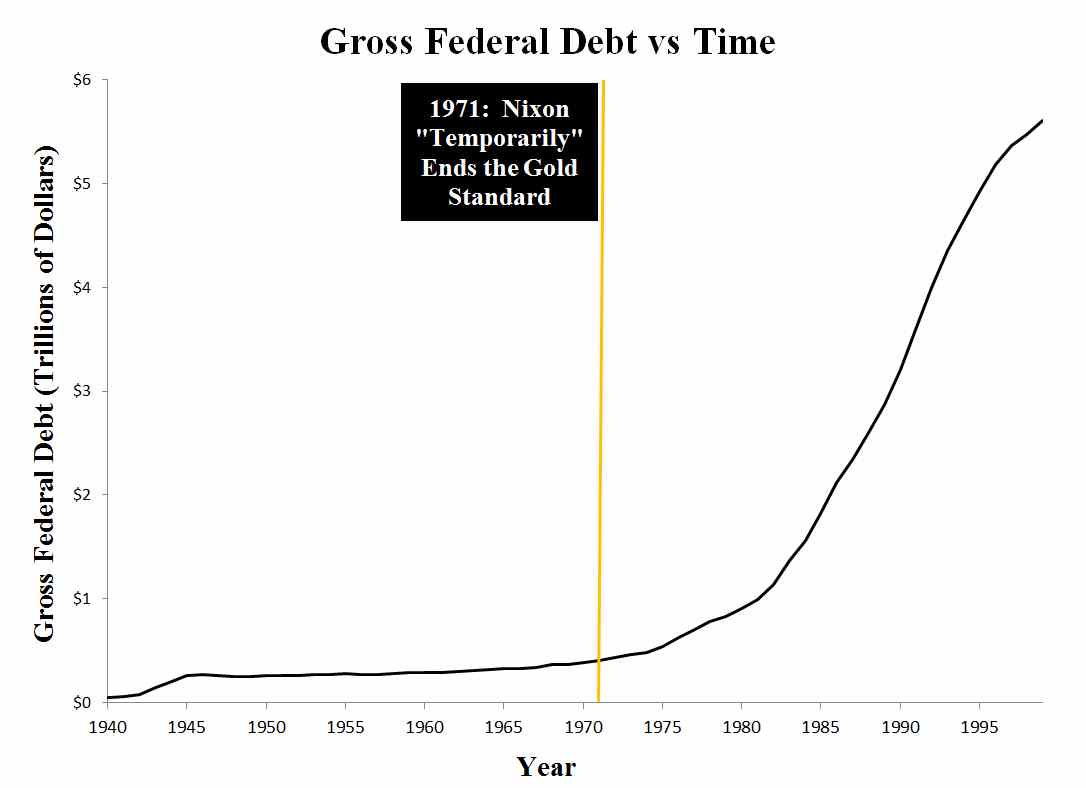
I thought it would be a fun exercise to display how government debt affects Our freedom. As a measure of freedom, I will use the United States incarceration rate - which is the highest in the world - and compare it to the gross federal debt for the period of 1940-1999. I think you will find that the results are telling.
Consider the following graphs. The first shows the incarceration rate as a function of time (red curve), and the second is a plot of gross federal debt as it has grown over time (black curve). Notice the similarity in the curves. Both indicate when the U.S. was taken off the gold standard by Nixon.
They look very similar. Don't they? Given the striking resemblance of the two, one may have a feeling a correlation exists. Well, what would a curve look like that plotted the incarceration rate as a function of the gross federal debt? See below.
Damn near a straight line! The R2 value is used as a measure to determine the degree of correlation between two sets of data (for those not familiar with statistics). The closer R2 gets to one, the stronger the likelihood a relationship exists between the two sets. ~0.99 is about as close to one as it gets!
This data would lend support to the hypothesis that - "As the federal government gets deeper and deeper in debt, society becomes less and less free" - just as an Austrian would predict.
How about we get that budget balanced?
Follow @DerrelWalters
Showing posts with label Austrian economics. Show all posts
Thursday, September 6, 2012
Tuesday, December 13, 2011
Deductive vs Inductive Reasoning
Deductive reasoning is exemplified by formulating conclusions based on logic rooted in firm, true, fundamental facts (axioms). For instance, a person sees a winged animal. The person concludes the animal can fly based on that evidence. This conclusion has a high probability of being correct and is an exercise in deductive reasoning.
What is inductive reasoning? Inductive reasoning takes observational evidence and reverse engineers the situation to find a likely cause. Let us look at the winged animal example from a different angle. Suppose the person sees the same animal high above in the sky, too high to see the animal's wings. The observer now concludes, based on the evidence, that the animal must have wings. Again, this conclusion is highly probable, but the person would only know absolutely if the animal landed or flew at a lower altitude.
So, what is the purpose for comparing and contrasting these two types of logical reasoning? I have heard it suggested by opposing groups that these two approaches are mutually exclusive to such a degree that only one or the other is valid in certain situations. It is here where my opinion differs.
The approaches are mutually exclusive for the most part (there is an exception)*, but deductive and inductive reasoning are necessarily complementary in most practical problem solving scenarios. This is the origin of my dissent. Let me give an example.
Imagine a mechanic that starts a new job in a factory. Let us track his approaches to problem solving as he gains more and more experience.
In the beginning, the mechanic has little knowledge about the factory's machinery. He relies primarily on the knowledge of those men or women with more experience to provide him with the solutions to the most common problems they have encountered.
If the mechanic is an independent person, he will, before asking anyone, try to diagnose the problems with the machinery through inductive reasoning. If something is getting hot, he will inductively construct reasons to explain the problem such as friction or faulty electrical equipment.
Suppose the overheating is a rare problem and his peers have no advice. The man has no choice but to approach the problem by taking the machine apart and exploring the parts. Here the mechanic learns fundamental information about the workings of the machinery, all while investigating the validity of his hypotheses concerning the overheating.
He uses the fundamental information about the parts of the machine, which parts move, which are static, etc. and employs deductive reasoning to narrow his search. He soon finds some worn bearings, a part many mechanics would likely suspect. He concludes the heat was caused by friction.
Awe! His inductive reasoning was correct. In addition, however, his deductive reasoning was just as handy. Both types of logical reasoning were equally important in his fixing the machine.
I would argue that the mechanic's tandem use of deductive and inductive reasoning is the most efficient method to solve problems. That is to say, it is important to weigh probable inductive scenarios against a foundation of fundamental knowledge, and allow deductive reasoning, based on that knowledge, to converge with the likely scenarios.
In other words, the likeliness of any one inductive scenario can be limited with good fundamental knowledge. For example, suppose the mechanic took apart the machinery and noticed that no electrical equipment was near the area where the overheating occurred. This fundamental knowledge immediately reduced the probability of electrical overheating to zero.
In the real world, the number of inductive speculations that should be considered can and must be practically limited by eliminating improbable scenarios based on a foundation of fundamental knowledge.
So, the lesson to be learned here is that gaining fundamental knowledge is very important to efficient problem solving by sharpening one's ability to formulate probable inductive scenarios. Always start with the fundamentals!
*Exception: Using the winged animal example from above, the person sees the animal up close and notices the wings. The person goes on to conclude that the animal has wings. Although this seems like a silly example, it is the only type of situation where deductive and inductive reasoning are equivalent. Follow @DerrelWalters
What is inductive reasoning? Inductive reasoning takes observational evidence and reverse engineers the situation to find a likely cause. Let us look at the winged animal example from a different angle. Suppose the person sees the same animal high above in the sky, too high to see the animal's wings. The observer now concludes, based on the evidence, that the animal must have wings. Again, this conclusion is highly probable, but the person would only know absolutely if the animal landed or flew at a lower altitude.
So, what is the purpose for comparing and contrasting these two types of logical reasoning? I have heard it suggested by opposing groups that these two approaches are mutually exclusive to such a degree that only one or the other is valid in certain situations. It is here where my opinion differs.
The approaches are mutually exclusive for the most part (there is an exception)*, but deductive and inductive reasoning are necessarily complementary in most practical problem solving scenarios. This is the origin of my dissent. Let me give an example.
Imagine a mechanic that starts a new job in a factory. Let us track his approaches to problem solving as he gains more and more experience.
In the beginning, the mechanic has little knowledge about the factory's machinery. He relies primarily on the knowledge of those men or women with more experience to provide him with the solutions to the most common problems they have encountered.
If the mechanic is an independent person, he will, before asking anyone, try to diagnose the problems with the machinery through inductive reasoning. If something is getting hot, he will inductively construct reasons to explain the problem such as friction or faulty electrical equipment.
Suppose the overheating is a rare problem and his peers have no advice. The man has no choice but to approach the problem by taking the machine apart and exploring the parts. Here the mechanic learns fundamental information about the workings of the machinery, all while investigating the validity of his hypotheses concerning the overheating.
He uses the fundamental information about the parts of the machine, which parts move, which are static, etc. and employs deductive reasoning to narrow his search. He soon finds some worn bearings, a part many mechanics would likely suspect. He concludes the heat was caused by friction.
Awe! His inductive reasoning was correct. In addition, however, his deductive reasoning was just as handy. Both types of logical reasoning were equally important in his fixing the machine.
I would argue that the mechanic's tandem use of deductive and inductive reasoning is the most efficient method to solve problems. That is to say, it is important to weigh probable inductive scenarios against a foundation of fundamental knowledge, and allow deductive reasoning, based on that knowledge, to converge with the likely scenarios.
In other words, the likeliness of any one inductive scenario can be limited with good fundamental knowledge. For example, suppose the mechanic took apart the machinery and noticed that no electrical equipment was near the area where the overheating occurred. This fundamental knowledge immediately reduced the probability of electrical overheating to zero.
In the real world, the number of inductive speculations that should be considered can and must be practically limited by eliminating improbable scenarios based on a foundation of fundamental knowledge.
So, the lesson to be learned here is that gaining fundamental knowledge is very important to efficient problem solving by sharpening one's ability to formulate probable inductive scenarios. Always start with the fundamentals!
*Exception: Using the winged animal example from above, the person sees the animal up close and notices the wings. The person goes on to conclude that the animal has wings. Although this seems like a silly example, it is the only type of situation where deductive and inductive reasoning are equivalent. Follow @DerrelWalters
Government Healthcare and Keynsian Economics
I believe the government subsidizes healthcare because they REFUSE to
encourage Americans to consume less. They say, "This could only hurt
the economy." However, by encouraging lethargy and excess over the
years, the government has, in essence, subsidized wasteful spending by
the citizenry.
It is always one subsidy to take care of the short-falling of another subsidy! They argue: "Last time, we just didn't spend enough. This is the reason for this RECURRING situation." This is a very circular argument to say the least! It is a dogma that continually adds to the inevitable downside of these type policies; the consequences become more serious the longer we continue.
So, what happens if the government were to take a different approach? What if, instead, they decided to form a committee to gather scientific evidence about all the health risks directly tied to our eating habits. In addition, the committee would build a strong case and start initiatives to better educate the public about the consequences which exist from such behavior. However, they avoid any subsidies, which can only create false demand and create hostility among market competitors due to fairness.
Likely, as with cigarettes, sound education would finally begin to overcome many of our vices (except for those that continue to CHOOSE to take part in risky behavior). This would entail a likely decline in the market for unhealthy foods and behaviors. The government would have you believe this is horrendous! We have lost jobs!
However, what happens in reality is a reallocation of employment to sectors such as the health food industry, gyms, etc. This is a natural process. Retrospectively, what occurred was that by subsidizing special interests, the government spurred a sort of false demand in economic sectors which otherwise would not have existed. WITH THE USE OF SUBSIDIZING POLICIES, THE GOVERNMENT REALLOCATES EMPLOYMENT TO AREAS OF THE ECONOMY WHERE IT OTHERWISE WOULD NOT HAVE BEEN!
This is an unavoidable fallacy of Keynesian economics. Follow @DerrelWalters
It is always one subsidy to take care of the short-falling of another subsidy! They argue: "Last time, we just didn't spend enough. This is the reason for this RECURRING situation." This is a very circular argument to say the least! It is a dogma that continually adds to the inevitable downside of these type policies; the consequences become more serious the longer we continue.
So, what happens if the government were to take a different approach? What if, instead, they decided to form a committee to gather scientific evidence about all the health risks directly tied to our eating habits. In addition, the committee would build a strong case and start initiatives to better educate the public about the consequences which exist from such behavior. However, they avoid any subsidies, which can only create false demand and create hostility among market competitors due to fairness.
Likely, as with cigarettes, sound education would finally begin to overcome many of our vices (except for those that continue to CHOOSE to take part in risky behavior). This would entail a likely decline in the market for unhealthy foods and behaviors. The government would have you believe this is horrendous! We have lost jobs!
However, what happens in reality is a reallocation of employment to sectors such as the health food industry, gyms, etc. This is a natural process. Retrospectively, what occurred was that by subsidizing special interests, the government spurred a sort of false demand in economic sectors which otherwise would not have existed. WITH THE USE OF SUBSIDIZING POLICIES, THE GOVERNMENT REALLOCATES EMPLOYMENT TO AREAS OF THE ECONOMY WHERE IT OTHERWISE WOULD NOT HAVE BEEN!
This is an unavoidable fallacy of Keynesian economics. Follow @DerrelWalters
A Practical Tax Plan: A Plan for Efficiency and Transparency
The income tax we pay to government is part of a system that produces the least accountability for politicians in Washington D.C. The generic label "income tax" is a disguise that hides from American citizens where there money is being spent. So, what should be done? Below, I outline a plan which returns more power to the citizenry and increases the accountability of elected officials.
Plan to Increase Transparency in the Tax System (PITT)
I will suggest to you that this is not a very difficult proposition. Of course, it is up to me to convince you of this.
Suppose you receive your paycheck and on the check stub there is a list of taxes in decreasing order of the top ten expenditures of where that tax money will ultimately been spent, what would be the consequences on the American tax payer and on the federal government?
Scenario:
John Smith, after being in such a tax system for some time, picks up his paycheck. He has noticed that on the news, the U.S. government has invaded a small country in Africa and realizes that, as a result, defense spending must increase.
Well, in the PITT system, there exists a mandate that the tax appropriations represented on the check stub must necessarily fluctuate with government spending.
Returning to John Smith, he notices all of the sudden that the category "Defense Spending" has increased by a large portion (although his actual tax burden may be similar as before). A light bulb appears above Mr. Smith's head.
Hmm... Mr. Smith thinks as the rolls of news flash through his head of the new invasion.
I leave you to imagine any particular outcome. However, a large number of "John Smith's" would become concerned and take this information into account the next time he enters a voting booth.
The PITT system returns power back to American citizens. We must hold our politicians accountable!
In addition, I will add that very few taxes should be levied as an income tax. Taxes should be generated by user taxes as much as possible, such as tolls on turnpikes. People that actually use the service pay for its convenience. However, national defense is a tax that must be levied on the entire population because we all benefit (or suffer) similarly.
Do not allow the U.S. government to continue to disguise the taxes under the alias "income tax."
Please leave comments. Your constructive criticism and suggestions are welcomed.
Follow @DerrelWalters
Plan to Increase Transparency in the Tax System (PITT)
I will suggest to you that this is not a very difficult proposition. Of course, it is up to me to convince you of this.
Suppose you receive your paycheck and on the check stub there is a list of taxes in decreasing order of the top ten expenditures of where that tax money will ultimately been spent, what would be the consequences on the American tax payer and on the federal government?
Scenario:
John Smith, after being in such a tax system for some time, picks up his paycheck. He has noticed that on the news, the U.S. government has invaded a small country in Africa and realizes that, as a result, defense spending must increase.
Well, in the PITT system, there exists a mandate that the tax appropriations represented on the check stub must necessarily fluctuate with government spending.
Returning to John Smith, he notices all of the sudden that the category "Defense Spending" has increased by a large portion (although his actual tax burden may be similar as before). A light bulb appears above Mr. Smith's head.
Hmm... Mr. Smith thinks as the rolls of news flash through his head of the new invasion.
I leave you to imagine any particular outcome. However, a large number of "John Smith's" would become concerned and take this information into account the next time he enters a voting booth.
The PITT system returns power back to American citizens. We must hold our politicians accountable!
In addition, I will add that very few taxes should be levied as an income tax. Taxes should be generated by user taxes as much as possible, such as tolls on turnpikes. People that actually use the service pay for its convenience. However, national defense is a tax that must be levied on the entire population because we all benefit (or suffer) similarly.
Do not allow the U.S. government to continue to disguise the taxes under the alias "income tax."
Please leave comments. Your constructive criticism and suggestions are welcomed.
Follow @DerrelWalters
Friday, December 9, 2011
A Plea to America: Do we need government intervention in all parts of our lives?
Over the last 70 or so years, the U.S. government has pursued an ever expanding policy of interventionism. Regulation and government involvement in our lives have been increasing at an alarming rate, and all these new laws to break has led us to have the highest rate of incarceration in the world, higher than any communist or tyrannical country. Below, I give a brief explanation of why government interventionism is, most of the time, unnecessary.
We ban drugs because we say they are harmful and can kill people. Is this policy based on sound logic? No matter what your position on the issue, please consider the following.
How many people have died from "The War on Drugs"? Well, literally tens of thousands of Mexican people are still dieing from this policy in addition to those that die everyday here in America.
Now, suppose the drug war had never been enacted. How many people would have died over the same time period from the use of now illegal substances? I would argue far fewer!
Take for instance, Coca-Cola, which still by the way uses a cocaine free extract from the coca plant (the only company still allowed to import coca leaves): Early consumers of Coca-Cola became concerned with its use of coca extract. People said, "Coca-Cola will make you a 'cocaine head'." Due to public pressure from the CONSUMER, not the government, the product soon eliminated the active alkaloid from the leaf extract to trace amounts until technology allowed the complete removal around 1930.
We do not need the government to be our nanny. We can take care of ourselves. Our history proves it. The U.S. has been here longer than 70 years. I beg you to explore our history prior to that.
It is a more educated and well informed consumer that improves our economy and directs labor to more efficient and higher demand economic sectors. In the 1990's, the U.S. government would have us believe that Microsoft would rule the computer industry forever. How many of you are now sitting on an Apple device reading this? That was the result of American innovation and American demand.
For the sake of us all, Americans please help stand up for our freedom! Bring awareness! Follow @DerrelWalters
We ban drugs because we say they are harmful and can kill people. Is this policy based on sound logic? No matter what your position on the issue, please consider the following.
How many people have died from "The War on Drugs"? Well, literally tens of thousands of Mexican people are still dieing from this policy in addition to those that die everyday here in America.
Now, suppose the drug war had never been enacted. How many people would have died over the same time period from the use of now illegal substances? I would argue far fewer!
Take for instance, Coca-Cola, which still by the way uses a cocaine free extract from the coca plant (the only company still allowed to import coca leaves): Early consumers of Coca-Cola became concerned with its use of coca extract. People said, "Coca-Cola will make you a 'cocaine head'." Due to public pressure from the CONSUMER, not the government, the product soon eliminated the active alkaloid from the leaf extract to trace amounts until technology allowed the complete removal around 1930.
We do not need the government to be our nanny. We can take care of ourselves. Our history proves it. The U.S. has been here longer than 70 years. I beg you to explore our history prior to that.
It is a more educated and well informed consumer that improves our economy and directs labor to more efficient and higher demand economic sectors. In the 1990's, the U.S. government would have us believe that Microsoft would rule the computer industry forever. How many of you are now sitting on an Apple device reading this? That was the result of American innovation and American demand.
For the sake of us all, Americans please help stand up for our freedom! Bring awareness! Follow @DerrelWalters
Subscribe to:
Posts (Atom)


